Design and implementation of an 8-microphone spherical array for real-time voice source localization using beamforming techniques

Course: Thesis I & II

Design and implementation of a spherical microphone array for real-time voice source localization in assistive robotics. The system integrates eight INMP441 digital MEMS microphones arranged over a spherical structure and an STM32H755 microcontroller for synchronized multichannel audio acquisition. The embedded system performs voice activity detection and transmits the acquired audio through Ethernet/UDP to a computer for signal processing. Spherical array processing and beamforming techniques are then used to estimate the direction of arrival of the acoustic source in terms of azimuth and colatitude. A 3D visualization interface developed with PyQtGraph and OpenCV displays the resulting spatial response, identifies the direction of maximum acoustic energy, and projects the estimated source direction onto a camera view. The project involved spherical array geometry design, 3D mechanical modeling, PCB interconnection design, embedded firmware development, multichannel audio acquisition, Ethernet communication, digital signal processing, beamforming, graphical interface development, and experimental validation of voice detection and source localization performance.

System Design and Implementation

Spherical Microphone Array

The prototype consists of eight MEMS microphones distributed symmetrically over a spherical structure. The mechanical design was developed to maintain the required microphone positions while integrating the internal wiring and electronics.
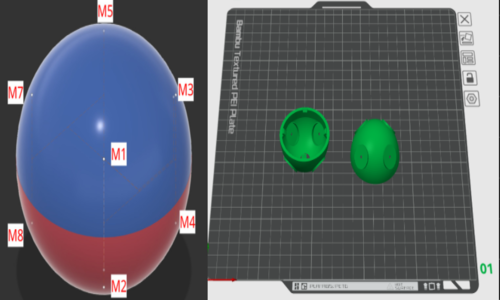
Eight-microphone spherical array prototype

Electronic Integration and PCB

A custom interconnection PCB was designed to reduce internal wiring and integrate the microphone connections with the STM32H755 development platform used for multichannel audio acquisition and communication.
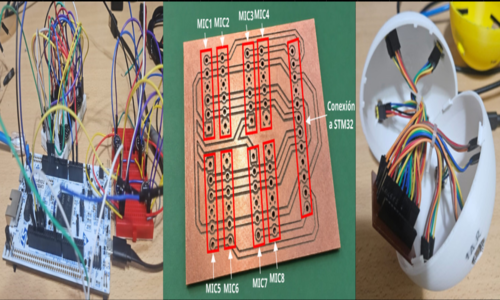
PCB and internal electronic integration of the spherical microphone array

Signal Processing and Visualization

3D Beamforming Response

The acquired multichannel signals are processed using spherical array techniques to generate a spatial response. The maximum of the resulting beamforming pattern is used to estimate the direction of arrival of the voice source.
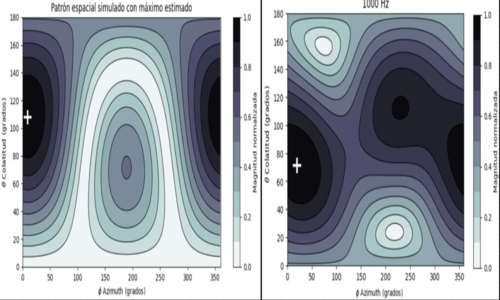
Three-dimensional beamforming response for voice source localization

Real-Time Localization Interface

A graphical interface developed with PyQtGraph and OpenCV visualizes the spatial response and projects the estimated source direction onto the camera view, providing an intuitive representation of the detected voice location.
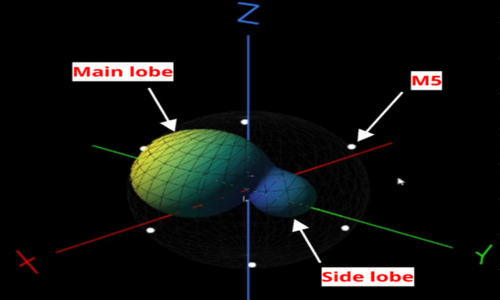
Real-time graphical interface for voice source localization